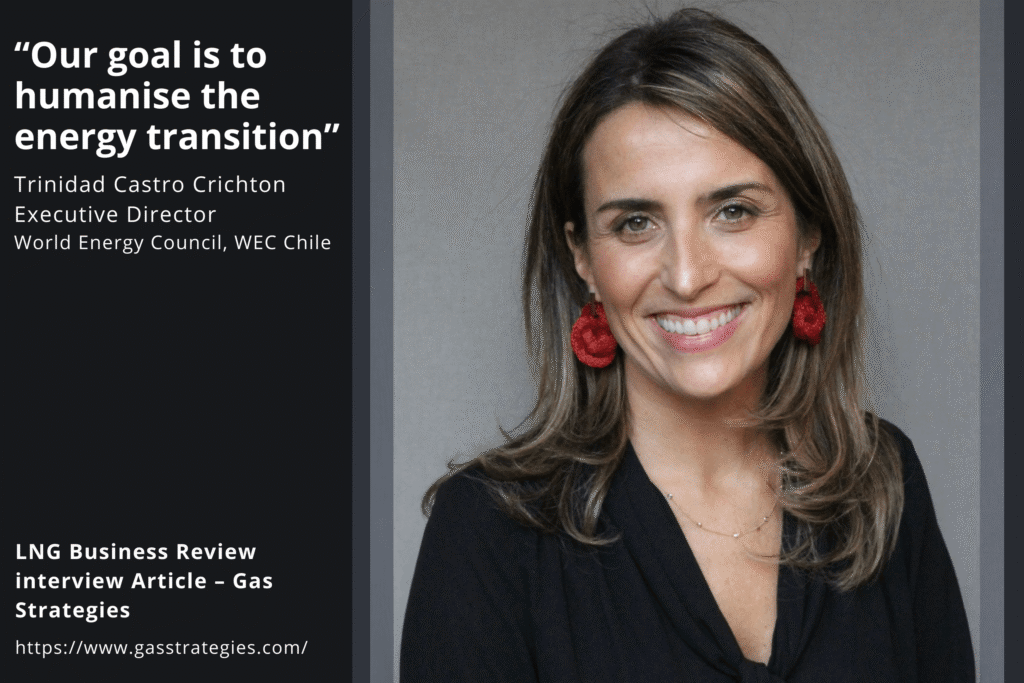
For the purpose of decarbonisation, objectivity is crucial, Trinidad Castro Crichton, executive director of the World Energy Council’s Chilean member committee, believes. The past few years have seen her country embark on an ambitious energy programme spearheaded by renewables, which Chile hopes will lead it to become a top producer and global supplier of green hydrogen.
But while the ultimate goal of net-zero emissions is something all energy sectors should strive for, decarbonisation needs to happen step by careful step, taking into consideration each country’s resources, otherwise the remedy, such as a badly planned switch away from a fossil fuel, can be worse than the disease, Castro says in this interview with LNG Business Review.
The human factor
Castro, who studied in business and economics, has a degree in public policy and relational mindfulness, and whose career has involved working in management for non-profit organisations and teaching at university, only entered the energy sector a few years ago.
“I never worked in something related to energy, but my experience working for different causes involving vulnerable people is what led to my being recruited by WEC,” says Castro. “This is because the organisation’s goal is to promote a sustainable energy system centred on the wellbeing of people, now and for future generations – to put a name and face in this process we’re going through, which is something I feel strongly about. Our main goal at WEC is to humanise the energy transition, put people in the centre of the problem”.
A big component of Castro’s role is to meet with representatives of all aspects of the energy sector and “get them together around a table to create dialogue, make commitments to each other. They all have their personal and individual interests, but at this table the aim is to work towards the same purpose, which is to build together a more sustainable energy system,” she says. “It is a big purpose that keeps me mobilised”.
Castro admits that, initially, she was concerned that her lack of experience in energy would be a hindrance to her new role with WEC. “I’m not a technician. I didn’t know about energy, gas, renewables or green hydrogen, so I was worried. But on my first week, Angela Wilkinson, WEC’s secretary general – an extraordinary woman – called me from London and said that, because I don’t come from the oil, gas, coal or renewables sectors, we can be neutral in our effort to bring experts from these fields, who have their own interests and sometimes fight with each other, together and make them commit towards the same goal. She reminded me that behind the politics and decision makers you find people, and what matters is to create a sincere, confident dialogue where you can find solutions to what you’re doing and generate a virtuous circle”.
According to Castro, “if you’re neutral, objective, you can pressure people to act no matter what they represent and challenge their prejudices. We need a neutral t